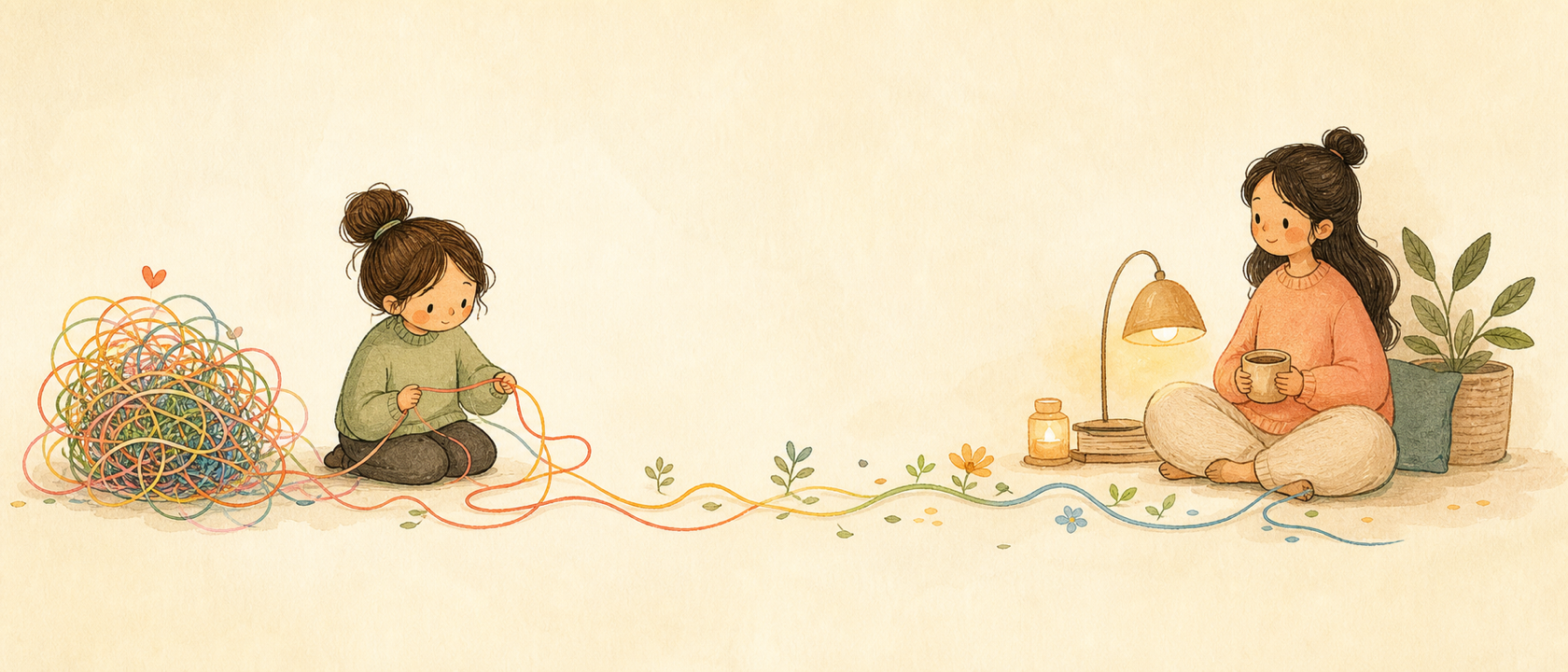
How to deal with relationship anxiety starts with one uncomfortable truth: you cannot think your way out of it. Positive affirmations and reminding yourself that "everything is fine" rarely stick because relationship anxiety is not a thinking problem — it is a pattern problem. Specific cycles of worry, reassurance-seeking, and avoidance keep it alive. Breaking those cycles, one at a time, is how things actually change.
This article gives you the practical steps. If you want background on what relationship anxiety is and where it comes from, the flagship overview covers that in depth. Here, the focus is on what to do.
Not sure how much relationship anxiety is affecting you?
Take the free, confidential self-assessment to get a clearer picture — no sign-up required.
Stop Seeking Reassurance as Your Main Relief Strategy
Reassurance feels like the obvious fix. You feel anxious, you ask your partner if they still love you, they say yes, and for a short time the anxiety settles. The problem is that it settles for a shorter and shorter period each time.
This is the reassurance loop: anxiety triggers a request for reassurance, reassurance provides temporary relief, but because the underlying anxiety was never addressed, it returns — often stronger, and with a new question attached. Over time, you need more reassurance to get the same relief. Your partner starts to feel interrogated. The relationship becomes a place where anxiety gets managed instead of connection happening.
Breaking the loop does not mean pretending you are fine. It means learning to tolerate the anxious feeling without immediately neutralizing it with a question. When you feel the urge to ask for reassurance, pause. Notice the urge. Let a few minutes pass. Often the intensity drops on its own — and when it does, you have just taught your nervous system that it can handle uncertainty without external confirmation.
This is one of the hardest shifts to make, and one of the most important.
Separate the Thought From the Fact
Relationship anxiety distorts perception. When you are in the middle of it, what relationship anxiety feels like is not a suspicion — it feels like certainty. "They are pulling away." "They are losing interest." "Something is wrong."
A small but powerful shift is to name what is actually happening: you are having a thought, not observing a fact.
Instead of: "They are pulling away." Try: "I am having the thought that they are pulling away."
This is not denial. You are not telling yourself the thought is wrong. You are creating a small amount of distance between the thought and yourself — enough space to ask: is there concrete evidence for this, or is anxiety filling in the gaps?
Most of the time, when you look for specific, observable evidence rather than feelings, the certainty dissolves. Your partner was quiet at dinner. That is the fact. Everything beyond that — what it means, what they are thinking, what will happen — is your mind constructing a story under the influence of anxiety.
Build Tolerance for Uncertainty in Small Doses
Relationship anxiety feeds on certainty-seeking. Every reassurance, every checked text thread, every replayed conversation is an attempt to eliminate uncertainty. But uncertainty is not the problem — low tolerance for uncertainty is.
You can build that tolerance the same way you build physical tolerance: gradually, with repetition, starting small.
Pick one low-stakes situation each day where you would normally seek reassurance or check something, and sit with it for ten minutes instead. Your partner has not responded to a message. Instead of sending a follow-up, wait. Notice what happens in your body. Notice the thoughts that arrive. Let them be there without acting on them.
Over time, this practice shifts your baseline. Uncertainty stops feeling like a threat that demands immediate action and starts feeling like something you can simply experience and move through. This is not about becoming indifferent — it is about becoming more steady.
Look for the Trigger, Not Just the Feeling
Relationship anxiety rarely arrives without a cause, but the cause is often not what it appears to be. Why you have relationship anxiety often has roots in earlier experiences — but on a day-to-day level, specific triggers make it spike.
When anxiety hits, it is worth asking: what else is happening right now?
- Is it late in the day when you are tired and your defenses are lower?
- Did something stressful happen at work that has nothing to do with your partner?
- Are you under-slept, hungry, or physically unwell?
- Did something in the last 24 hours remind you of a past relationship?
Anxiety borrows from everything. When your stress levels are high, your nervous system is already sensitized — and your relationship becomes the target because that is where you are most emotionally invested. Recognizing this does not make the anxiety go away, but it stops you from treating a manageable feeling as evidence that your relationship is falling apart.
Keep a simple log for a week: when did anxiety spike, what time was it, what had just happened. Patterns become visible quickly, and patterns can be worked with.
Slow Your Reaction Time
Anxiety creates urgency. The feeling is so uncomfortable that doing something — sending a message, asking a question, picking a fight — feels necessary. Acting on that urgency is almost always counterproductive.
The single most practical skill in managing relationship anxiety is learning to insert a pause between the feeling and the action.
When you feel the pull to seek reassurance, send a worried message, or start an argument to discharge tension: wait. Set a ten-minute timer if you need to. During that time, do something that engages your body — walk, drink water, breathe slowly. You are not suppressing the feeling. You are giving your nervous system enough time to shift from reactive to reflective.
After ten minutes, you can still do whatever you were going to do. But most of the time, you will not want to. The urgency fades, and what felt like a necessary action reveals itself as an anxiety response looking for an exit.
Feeling stuck in patterns of worry and not sure where to start?
Mindfulmate is available on WhatsApp as a private, judgment-free space to talk through what you are experiencing, anytime.
Communicate Without Asking for Reassurance
There is a version of open communication that helps, and a version that deepens the reassurance loop. The difference is in how you frame what you share.
Asking for reassurance: "Do you still love me?" / "Are you sure you are not losing interest?" / "You would tell me if something was wrong, right?"
Sharing your experience: "I have been feeling anxious lately and I am working on it." / "I noticed I was feeling unsettled earlier — I think it is just something I am sitting with."
The second approach is honest without putting your partner in the position of being your anxiety management system. It invites connection without demanding confirmation. Over time, how anxiety affects relationships often comes down to this distinction — whether the relationship becomes a space for genuine closeness or a place where anxiety gets constantly regulated.
This kind of communication takes practice. It helps to prepare what you want to say before a conversation, especially when you can feel that anxiety is shaping your words.
Build a Sense of Self That Exists Outside the Relationship
One of the quieter drivers of relationship anxiety is an over-reliance on the relationship for identity and self-worth. When your sense of who you are and whether you are okay depends on how your partner treats you in any given moment, the stakes of every interaction become enormous.
This is not a character flaw — it often develops naturally, especially in people who have experienced how to cope with anxiety in a relationship by becoming hyper-focused on their partner as a source of safety.
The work here is gradual: rebuilding or strengthening parts of your life that are yours alone. A pursuit, a skill, friendships, time you spend in ways that have nothing to do with your partner’s presence or approval. This is not about emotional withdrawal from the relationship. It is about distributing the weight — so that your self-worth does not rise and fall with your partner’s mood.
When you have a stable sense of yourself that does not depend on constant validation, the relationship becomes less of a tightrope and more of a foundation.
When It Is Harder to Deal With Alone
Relationship anxiety responds to consistent, deliberate practice. But some patterns run deep — rooted in early attachment experiences, past relationships, or anxiety that has become entangled with other areas of life. In those cases, the steps above help, but they may not be enough on their own. The National Institute of Mental Health describes CBT as a research-supported treatment for anxiety disorders, which is one reason therapy can help when self-help alone stops moving the pattern.
Signs that it may be worth getting support:
- The anxiety has been persistent for months and is not responding to self-help
- It is causing you to avoid intimacy, sabotage relationships, or act in ways you regret
- It is affecting your ability to function at work or in other areas of life
- You have been through multiple relationships and the same patterns keep appearing
Relationship counseling and individual therapy — particularly approaches focused on attachment — can help you understand and shift the patterns at their root, not just manage their effects. Dealing with anxiety in a new relationship is explored specifically in this article on new relationship anxiety.
How Mindfulmate Fits In
Mindfulmate is not therapy, and it does not replace it. What it offers is something different: support in the moments between, when anxiety is high and talking to someone would help, but there is no session scheduled and no one to call.
Through WhatsApp or Telegram, you can talk through what you are experiencing — without judgment, without an appointment, without having to explain yourself from the beginning every time. Mindfulmate works as a space for reflection, for trying out what you might say to your partner, or simply for not sitting with something alone.
If you are working through the steps in this article, having a place to process in real time can make the difference between insight that fades and change that holds.
You do not have to figure this out on your own.
Start a private conversation in the chat app you prefer — available anytime and completely confidential.
Mindfulmate provides emotional support and guidance for everyday stress and anxiety. It is not a substitute for professional mental health treatment. If you are in crisis or need urgent support, please contact a qualified mental health professional or emergency services.