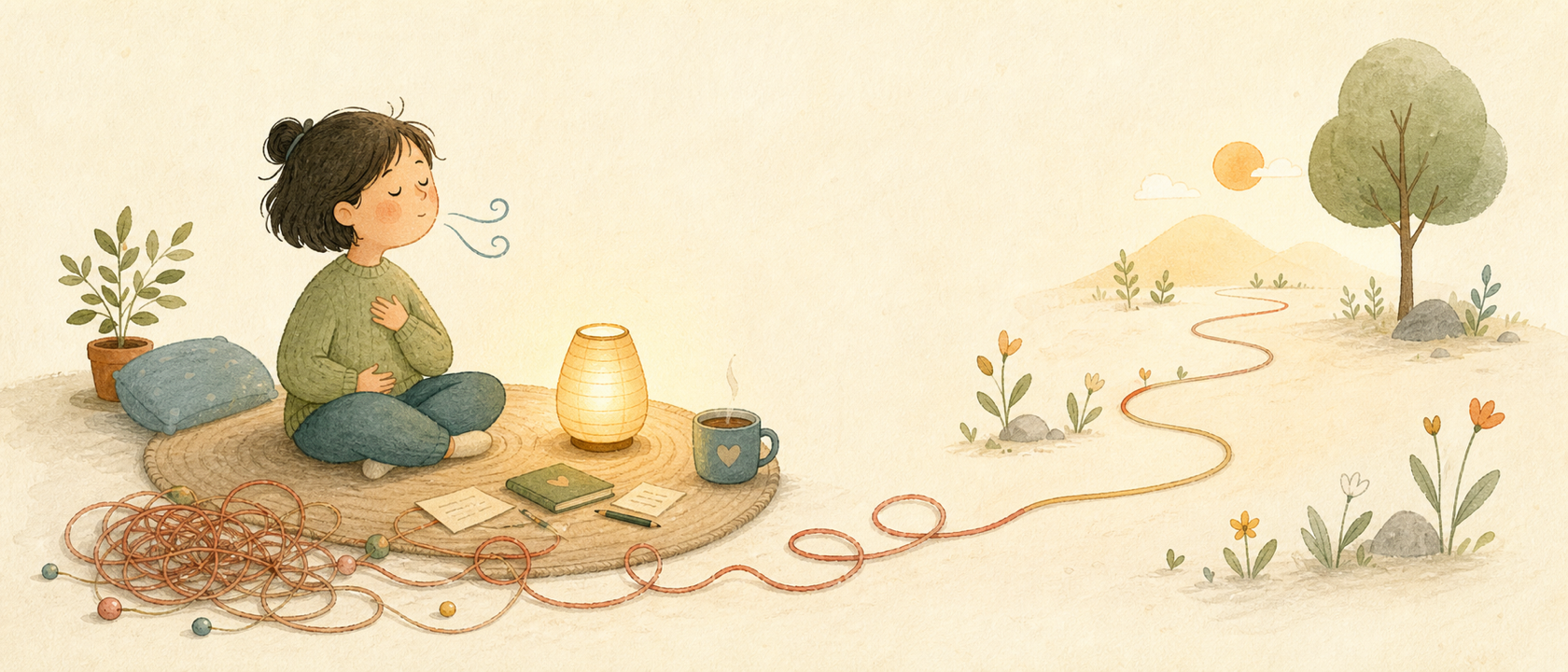
How to cope with anxiety in a relationship starts with a simple shift: coping does not mean making the anxiety disappear. It means you can feel it without it running the show — you can pause before you react, stay present with your partner, and move through the moment without making things worse. That is what coping looks like in practice.
This article is about what to do right now, and what to build into your daily life, so that anxiety does not take over.
Not sure how much anxiety is affecting you?
Take the free, confidential self-assessment to get a clearer picture.
What Coping Actually Means
There is a difference between coping and fixing. Coping means you have enough steadiness to respond well, even when anxiety is loud. You are not waiting until you feel calm to act — you are building the capacity to act calmly despite how you feel.
If you are looking for a deeper approach to changing the underlying patterns of relationship anxiety, that work exists and it is worth doing. But right now, if you are in the middle of a spike or just trying to get through the week, these are the tools that help. The National Institute of Mental Health notes that stress-management techniques such as exercise, mindfulness, and meditation can reduce anxiety symptoms when paired with standard care.
In-the-Moment Coping: When Anxiety Spikes
Ground yourself before you respond
When anxiety spikes — your partner takes a few hours to reply, they seem distant, something they said catches in your mind — the worst time to send a message or start a conversation is right then.
Give yourself sixty seconds first. Name five things you can see in the room. Take three slow breaths, breathing out longer than you breathe in. The goal is not to talk yourself out of how you feel. The goal is to create a gap between the feeling and your response. That gap is where you get to choose what happens next.
Name the physical sensation without acting on it
Relationship anxiety often shows up in the body first — a tightness in the chest, a knot in the stomach, a kind of restless energy that wants to do something. When you notice that sensation, name it directly: "My chest is tight. That’s the anxiety."
That label matters. It reminds you that what you’re feeling is a physical response, not a signal that something is actually wrong. What relationship anxiety feels like is often alarming — but the alarm does not mean there is a fire.
Write it down before you say it
When anxiety spirals, it wants an audience. It wants you to reach out, ask for reassurance, or raise the thing that is worrying you — right now, regardless of whether the timing is right.
Before you do any of that, write it down privately. Get the spiral out of your head and onto a page. Often you will find that what felt urgent is more manageable once it is in front of you. And if you still want to raise it with your partner after writing, you will do it more clearly and more calmly.
Ask what you would tell a friend
This is one of the most effective resets when anxiety distorts your thinking. Imagine a friend came to you with exactly the situation you are in right now — the same partner, the same interaction, the same worry. What would you say to them?
You would probably be kinder than you are being to yourself. You would probably see more than one explanation. Let that perspective in.
Need support in the moment?
Talk things through on WhatsApp with private, judgment-free support whenever you need it.
Day-to-Day Coping: What to Build Into Your Routine
Create rituals that do not depend on reassurance
Reassurance feels good in the moment, but it feeds the cycle. If every positive feeling in the relationship comes from your partner confirming that things are okay, you will keep needing more of it.
Build in low-stakes shared rituals — a morning check-in, a walk, cooking together — that are just about being in each other’s company. These create a base of connection that is not anxious by design. They remind you, at a body level, that the relationship is stable. That stability is what actually reduces the background hum of worry over time.
If you want to understand more about how anxiety affects relationships over time, that is worth reading alongside this.
Reduce the intensity of triggers where you can
You cannot eliminate anxiety triggers, but you can stop feeding them. If you know you spiral when your partner does not reply quickly, do not watch the delivered receipt. Mute notifications for thirty minutes at a time instead of refreshing. If you know certain conversations go badly in the evenings when you are both tired, move them to the morning.
This is not avoidance. Avoidance means you never deal with the thing. This is managing the conditions so you are in a better state when you do.
Build support outside the relationship
Your partner cannot be your only resource for managing anxiety. That is too much pressure on them and too much dependence for you. A friend you can call, a journaling habit, a regular check-in with yourself — these build a support structure that does not rely on your relationship being in a good moment.
An on-demand tool like Mindfulmate can be part of that structure. Talking through what you are feeling at the moment it comes up — without worrying about timing or burdening someone — can help you process the anxiety before it becomes a problem in the relationship.
Why relationship anxiety happens is worth understanding too, especially if you find the same patterns repeating. Knowing the root makes the day-to-day habits easier to stick to.
When Coping Is Not Enough
These tactics are genuine tools. They work. But they are not a replacement for working through the deeper patterns — the attachment history, the beliefs about yourself and relationships, the habits that have built up over time.
If you find that the anxiety is constant, that your relationship is suffering, or that you are exhausted from managing it, that is a sign to go further. How to deal with relationship anxiety covers the more structured approaches, including when professional support makes sense. Relationship counseling is one option worth knowing about.
You do not have to wait until things are bad to get support. Getting support now, while you are still coping, makes it easier to stay ahead of the anxiety rather than catch up to it.
Want a private space to talk this through?
Start a conversation in the chat app you prefer whenever the anxiety starts to build.
Mindfulmate provides emotional support and guidance for everyday stress and anxiety. It is not a substitute for professional mental health treatment. If you are in crisis or need urgent support, please contact a qualified mental health professional or emergency services.